YOLO Dataset Forge converts YOLO, COCO, VOC, LabelMe and CVAT, auto-fixes the label bugs that silently ruin training, and splits by patient, session or video so your validation scores mean something.
One-time payment · single-user commercial license · free 1.x updates · secure checkout by Stripe

The model is rarely the hard part. The dataset plumbing is, and its bugs don't crash anything. They just quietly make your model worse or your metrics too good to be true.
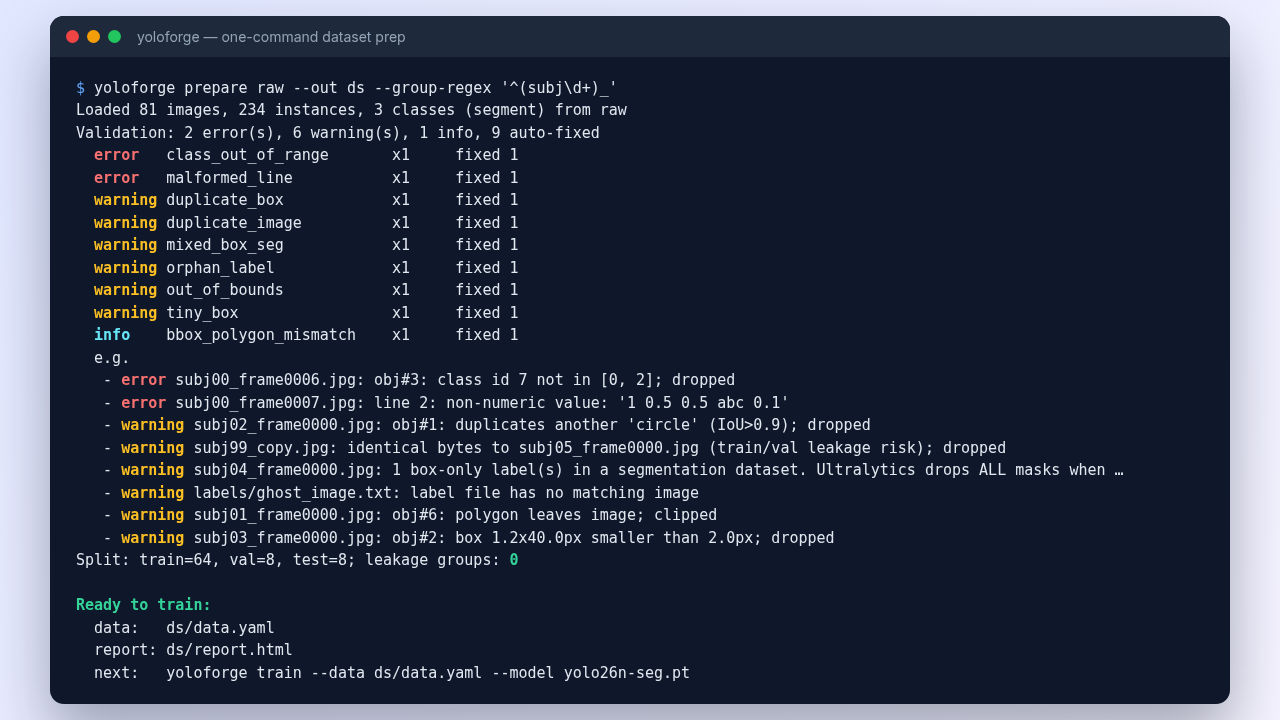
Boxes outside the image, class ids out of range, pixel coordinates instead of 0–1, duplicate boxes, EXIF-rotated photos. And one nasty one: a few box-only rows in a segmentation set make Ultralytics silently drop all masks.
Your annotation tool exports COCO, VOC, LabelMe or CVAT. YOLO wants normalized txt files, a strict folder layout and a data.yaml. Fixing labels means converting back again. Most projects end up with a pile of one-off glue scripts.
Frames from the same patient, video or session land in both train and val. The model "recognizes" near-duplicates, val mAP looks great, and real-world performance doesn't follow. Rare classes may never reach val/test at all.
A small, readable Python toolkit and CLI (yoloforge) that runs entirely on your machine. No account, no upload, no telemetry.
YOLO (detect + segment) ⇄ COCO JSON ⇄ Pascal VOC ⇄ LabelMe ⇄ CVAT for images 1.1 XML. Polygons included, multi-part COCO polygons merged, formats auto-detected, class order enforceable with --classes.
20+ checks: malformed lines, pixel coords, out-of-range classes, out-of-bounds/inverted/tiny/duplicate boxes, degenerate polygons, mixed box/seg rows, image size mismatch, corrupt or duplicate images. Fixes go to a new folder; your source data is never modified.
Multi-label iterative stratification (Sechidis et al., 2011) over groups from --group-regex. All frames of one patient/session/video stay in one split, rare classes still reach val/test, and a leakage check confirms it. Same seed, same split.
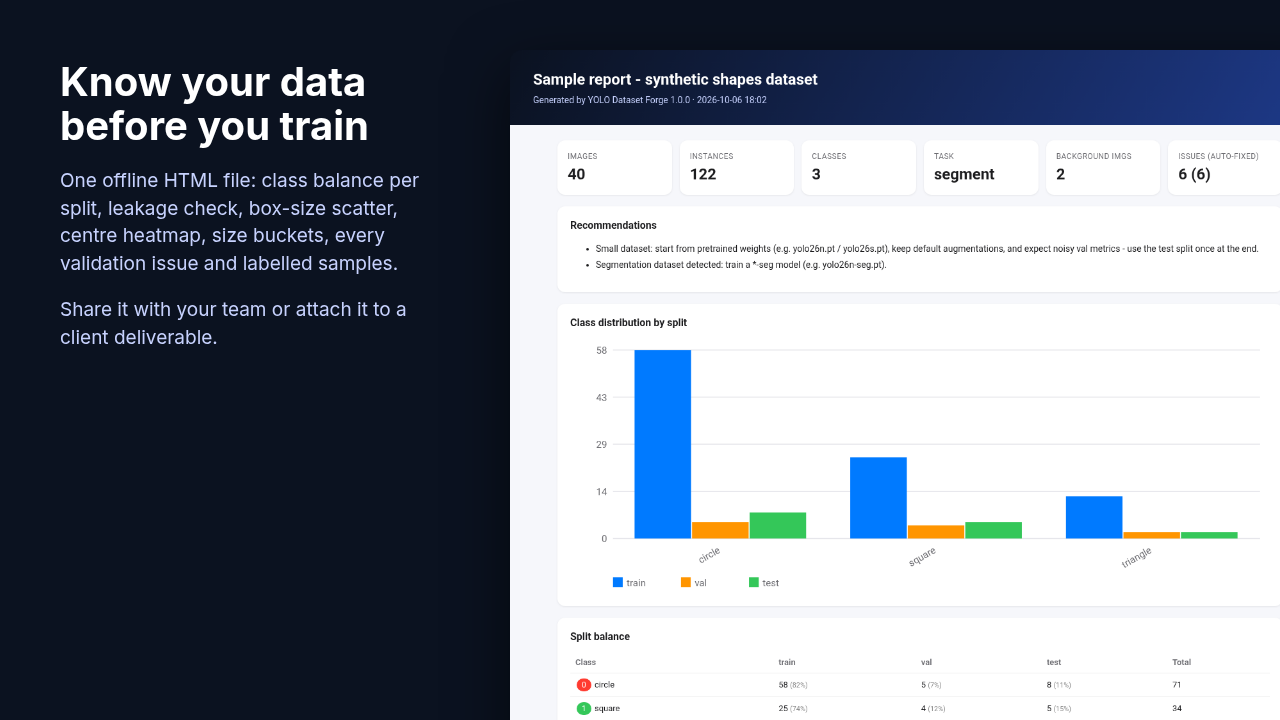
One self-contained file: class balance per split, leakage check, box-size scatter, centre heatmap, size buckets, aspect-ratio and objects-per-image histograms, every issue found, labelled thumbnails and recommendations.
Draw boxes and polygons onto images to eyeball labels before you spend GPU hours. validate --strict exits non-zero on unfixed errors, so it works as a CI gate.
Thin wrappers that call your own Ultralytics yolo CLI, with task auto-detection, --dry-run, and presets for a CPU smoke test, small datasets and small objects.
yoloforge prepare runs validate, auto-fix, stratified group split, YOLO layout, data.yaml, report.html and validation.json in one go.
# install the wheel you receive $ pip install ./yoloforge-1.0.0-py3-none-any.whl # try it on the bundled synthetic data (deliberately broken labels) $ yoloforge synth --out raw --n 80 --inject-errors $ yoloforge prepare raw --out dataset --group-regex '^(subj\d+)_' # your own COCO export from CVAT / Label Studio / Roboflow / ... $ yoloforge prepare path/to/instances.json --images path/to/images --out my_dataset # train with your own Ultralytics install $ yoloforge train --data my_dataset/data.yaml --model yolo26n.pt --epochs 100
my_dataset/images/{train,val,test} and labels/{train,val,test} in the standard YOLO layoutdata.yaml ready for yolo trainreport.html: class balance, leakage check, geometry, issues, thumbnailsvalidation.json: every issue found and what was fixedOther commands: convert, validate [--fix] [--strict], split, report, visualize, synth, train, eval, export. There's also a Python API (read_dataset, validate, stratified_split, build_report).

The report is a single offline HTML file you can share with your team or attach to a client deliverable. Here's a real one generated from the synthetic sample dataset.
Open the sample report →yoloforge package + CLI) and a ready-to-install wheeltrain / eval / export and install it yourself (pip install ultralytics)The free tools below are excellent, and many people should just use them. Forge is for when you want conversion, validation, group-aware splitting and a report in one offline command. Here's an honest look at where each one fits.
| Forge | Ultralytics converters | supervision | labelme2yolo | FiftyOne | Roboflow | |
|---|---|---|---|---|---|---|
| Main strength | One-command dataset prep for YOLO | Built into the YOLO toolchain | Flexible CV utilities library | Simple LabelMe → YOLO | Visual dataset exploration & curation | End-to-end hosted platform |
| Formats → YOLO | COCO, VOC, LabelMe, CVAT | COCO (+ some others) | COCO, VOC | LabelMe | Many formats | Many (via upload) |
| YOLO → back to annotation formats | COCO, VOC, LabelMe, CVAT | — | COCO, VOC | — | Many formats | Many (via upload) |
| Validation + auto-fix of label errors | 20+ checks, fixes to a new folder | — | — | — | Explore / find issues visually | Partial (health check) |
| Stratified multi-label split | Yes | Random | Random | Random | Via your own code | Random |
| Group-aware split (no patient/session leakage) | Yes + leakage check | — | — | — | Via your own code | — |
| Offline HTML dataset report | Yes, single file | — | — | — | Interactive app instead | Web UI |
| Offline, data stays on your disk | Yes | Yes | Yes | Yes | Yes (open-source version) | Cloud upload |
| Price / license | $29, single-user commercial | Free, AGPL-3.0 (or Enterprise) | Free, MIT | Free, open source | Free open source; paid Enterprise | Free tier + paid plans |
Based on our reading of each project's public documentation, October 2026. These tools change quickly, so check their docs for the current feature set. If you spot an error, please tell us and we'll fix it. All trademarks belong to their owners.
Short answers. The full details are in the README and LICENSE that ship with the kit.
A perpetual single-user commercial license. You can use Forge on any computers you personally use, for personal, academic and commercial work, including work for your employer or clients. Datasets, reports, configs and models you produce are yours, with no royalties. You can modify the code for your own use. You can't redistribute or resell the code, publish it in a public repository, share one license between several people, or offer it as a hosted service. Teams need one license per user.
No. YOLO Dataset Forge is an independent product, not affiliated with or endorsed by Ultralytics. It contains no Ultralytics code and ships no model weights. Convert, validate, split, report and visualize don't need Ultralytics at all. The train, eval and export commands simply run the yolo program that you install separately. Ultralytics is licensed under AGPL-3.0 (or a paid Ultralytics Enterprise License), and pretrained weights are downloaded under its terms. Shipping Ultralytics-based models in a closed product or network service may require an Enterprise License. That's between you and Ultralytics, and this isn't legal advice.
Yes. Within 14 days of purchase, email kryszut83@gmail.com and briefly tell us why it didn't work for you, and you'll get a full refund.
Instantly. Right after checkout, the Stripe confirmation page shows your download link for the zip. Save that link.
Python 3.9 or newer on Linux, macOS and Windows. It's pure Python with two dependencies (Pillow, PyYAML), and no GPU is needed for dataset work.
If one of these is a blocker for you, please wait or ask before buying.
No. Fixes are always written to a new output folder, and your source dataset is never touched. Keeping backups is still a good habit.
It writes the standard Ultralytics YOLO dataset layout and data.yaml, used by YOLO26, YOLO11 and YOLOv8 for detection and segmentation.
Yes. All 1.x updates are free.
$29 one-time · single-user commercial license · free 1.x updates
Buy YOLO Dataset ForgeSecure checkout by Stripe. Promo codes can be entered at checkout.